The post Nail your website keywords to improve SEO & website clicks appeared first on Rivmedia Web Design.
]]>Adding website keywords is vital to your marketing strategy and in helping your ideal clients find you online. You’ve seen and heard all the experts talking about how important it is. Actually doing it right though can be easier said than done if you don’t have a guide.
Don’t worry though, nailing this isn’t as difficult as you think. Like many things, there’s a formula; once you have that, things get much simpler. All you have to do is follow it, and watch your results improve!
In this article, I’ve set out, step-by-step how to implement your website keywords in a simple checklist. When you’re done, you can finally get more, higher-quality leads landing on your website.
First, let’s quickly cover the terminology:
Website Keywords: These are a word or phrase that tell search engines what the content on your website is about. It also refers to what people pop into search engines. If what they’re searching for matches the keywords used on your site, that’s how you show up in the search results. Your position in the results (ranking) depends on a number of factors. Getting your website keywords right is a very important one in your overall SEO strategy.
Focus keyword: You may have several keywords that you want your content to rank for, especially if your content is long. The focus keyword, however, is the primary keyword or phrase you want to rank for. It is used in your title, URL, meta description, text and images.
Long-tail keywords: These contain 3 or more words and are really effective in targeting a very specific market. For example, “Life Coach” is a very broad keyphrase and would have a tonne of competition. Therefore, it would be difficult to rank well for it. A long-tail keyword though such as “Melbourne Self Esteem Coach” is more specific, making it easier to rank as well as reach a more targeted audience.
SEO: Simply put, SEO (Search Engine Optimisation) is a combination of practices put in place to improve your appearance and ranking in search engine results. It includes things like keywords, using headings correctly, image alt tags, appropriate linking and more. As this article is focused on optimising your website keywords, we’ll just stick to that.

First, choose which website keywords to use
You need to find which search terms your target market is entering into search engines. Don’t just assume you know them. For best results, take the time to do some research. You might be surprised and even uncover some interesting and useful results.
For example, say you’re a relationship coach who offers support to those going through a divorce. Terms your potential clients might search for could include “How to cope with divorce”, or “dealing with divorce.” If you’ve written an article on these specific topics and optimised your keywords, you not only increase your chances of ranking higher (and getting more clicks!) but also increase your chances of reaching a very targeted audience and your ideal clients.
The point here is that you know your business inside out. So, your mindset of what you would search for online will vary from the mindset of your target market. Take the example above again. Some people may not even be aware of coaches that specialise in helping people through a divorce. So, they’re unlikely to search for your services specifically (e.g. “Divorce Coach”). After using the above search terms though, they could come across your website and find a really helpful article, initiating their customer journey with you. ?
Some tools to help you with your website keywords research:
- AnswerThePublic – get instant, raw search insights, direct from the minds of your customers. You can search 3 keywords per day for free.
- Google – pop in a keyword and look through the results for inspiration for more. Plus, down the bottom, Google even generates a list of “Related Searches”
- Google’s Keyword Planner – Find the right keywords with their research tool.
- Google Trends – This is a handy tool that analyses the popularity of search queries and compares search volume
- Ubersuggest is great for helping you discover new keywords. You can get a lot of data with the free option.
Once you have your keywords and have determined your focus keyword for your page, post, product etc. It’s time to optimise them. Here’s how…
1. The Title Tag
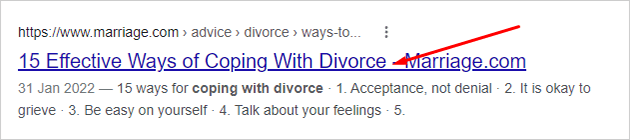
This is the blue link in Google search result pages that users click to go to your website. It is propagated either from your content or whatever you input into your SEO plugin or app (for WordPress users I recommend Yoast or RankMath).
Tips:
- Your focus keyword should be within the title and for best results, place it right at the beginning
- Your page title should be a H1 heading and there should only be one H1 heading, the rest should be sub-headings; H2-H6)
- Always try to include emotional words, power words or numbers (try Coschedules headline analyser for more info… and to make your titles more engaging!)
- It should be no more than 55-60 characters in length to ensure the whole title is visible (on desktops and mobile devices)
- You should always have unique title tags, don’t duplicate the same title tags on more than one page of your website
Example:
Focus Keyword: coping with divorce
Title Tag: Coping with Divorce: An essential guide to heal and move forward
2. The Meta Description
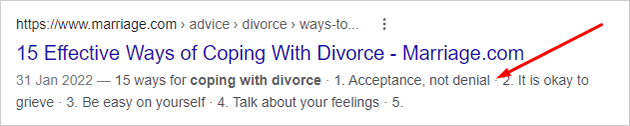
This is the snippet of text that appears below your Title Tag in search result pages. If the keywords being searched for are within your meta description, search engines will also make them bold, making them more visible and increasing your chances of click-throughs.
Tips:
- Include your focus keyword in the meta description. There isn’t an ideal location, just as long as it’s in there. Also, be sure to accurately summarise your page’s content, and make it engaging.
- It should be no more than 155-160 characters in length to ensure the whole snippet is visible (on desktops and mobile devices)
- As with title tags, you should always have unique meta descriptions, don’t duplicate them on more than one page of your website
Example:
Focus Keyword: coping with divorce
Meta Description: Coping with divorce can be intensely painful, causing substantial grief & stress. Our tips will help you process your emotions, heal & start to move on
4. URL
This is your page link. For example, www.yoursite.com
Tips:
- Remove less powerful words or stop words (and, or, but, of, the, a, etc.) to make it simple and precise, just make sure your focus keyword is still in there and that it makes sense.
- Shorter URLs have been shown to have a better chance of ranking higher than long URLs. There’s no hard and fast rule for the length, but aim to keep it as close to 75 characters or less. See our examples below.
- Use all lowercase letters and separate each word with a hyphen (-), don’t use underscores (_)
- They should be easily readable both by humans and search engines. In this URL for example, www.mysite.com/post?ID77&kw=coping+divorce – you can guess what the page’s content will include but it isn’t as clear as it could be
- Avoid using dynamic URLs when possible. This is a URL where the content for the page is pulled from the database. You can usually spot them as they include characters like: ? + &. They look messy and aren’t SEO friendly
- Don’t keyword stuff, your focus keyword should only be in the URL once.
Example:
URL from the title:
www.yoursite.com/coping-with-divorce-an-essential-guide-to-heal-and-move-forward/
URL shortened and stop words removed:
www.yoursite.com/coping-with-divorce-guide-move-forward/
URL with focus keyphrase only:
www.yoursite.com/coping-with-divorce/
5. Keyphrase in Introduction
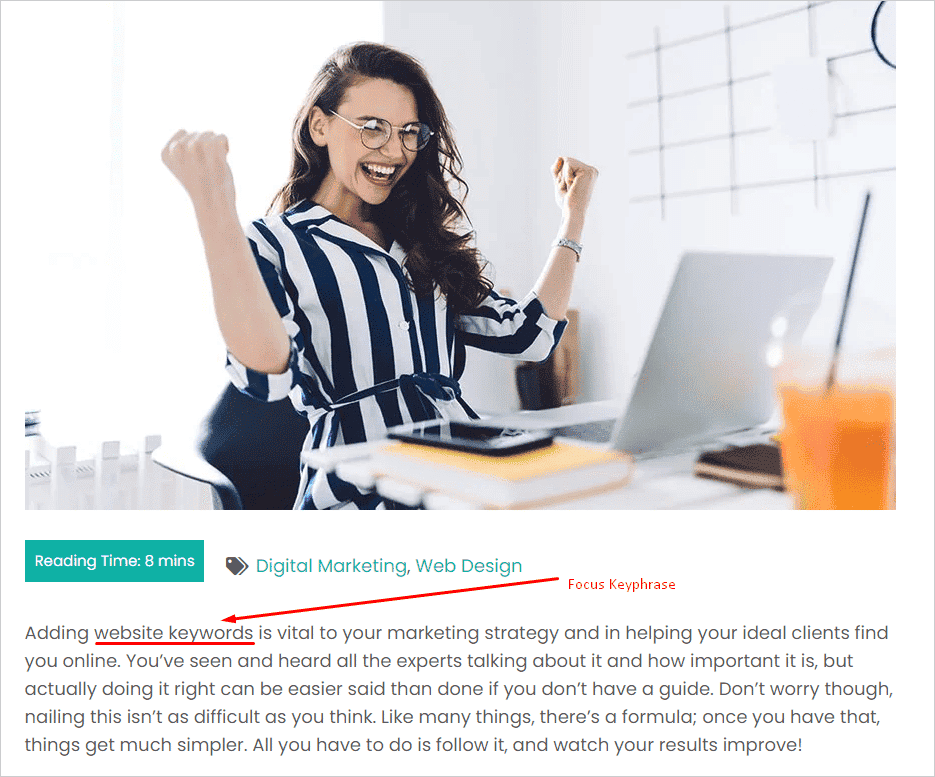
Your focus keyphrase should also be at the very beginning of your content. This reinforces what your content is about and also reassures site visitors that what they have clicked through to is what they are looking for (i.e. it’s not clickbait!)
Tips:
- Different plugins/apps will give different guidelines, such as it being within the first 10% of the content or within the first 100 words. A good rule of thumb is to make sure it is included within the first sentence
- This first sentence should be SEO optimised, but also still needs to make sense and sound natural. Another rule of thumb; write for your site visitors first and Google second
5. Sub-Headings and page content
We’ve already discussed including your focus keyphrase in your title (which if your website is set up properly should be a H1 tag). You should also include it in your sub-headings, i.e. H2, H3, etc. and body content (paragraphs).
Tips:
- Google pays the most attention to your H1 and H2 headings. However, the others are not ignored and should also be considered in your website keywords strategy.
- Many site visitors scan content, that’s why it’s also important to include your keywords in your headings to help grab their attention
- Seeing as the focus keywords should be related to the topic of the post, including them within your content (paragraphs, not just headings) should happen naturally, just ensure you don’t overdo it. Not only does it get irritating for readers to see the same words over and over again, but including them too many times can lead you to be penalised by Google if they see it as keyword stuffing
- There is no set rule for how many times your keyword should appear in your content, especially as the amount of content each page/post has can vary significantly. As a guide, aim for a density of 1-1.5%. What this means is for every 100 words, the keyword should appear 1 to 1.5 times.
- If in doubt, you are better off having a low keyword density than one that is too high. Keep your language natural; if the search engines don’t penalise you for it, your site visitors definitely will!
6. Image Name & ALT tags
An ALT tag specifies an alternate text for an image and improves accessibility for people who either can’t see the images or if they failed to load. Furthermore, they help search engines better understand not only what the image is about, but what your page’s subject matter is. They are also useful as anchor text should the image be used as a link.
Tips:
- Make the ALT text useful, informative and use keywords appropriately
- Avoid filling all image ALT tags with the same keywords over and over (this is also keyword stuffing)
- Don’t forget the image file name: Name it appropriately with hyphens separating each word, no funny characters, and all lowercase
- Naming your image and using appropriate ALT tags will also help in having your image show up in Google Image search results
Here’s a handy article on how to add ALT tags for your WordPress website as well as some more best practice guidelines.
And voilà, that’s it! ?
On a final note, I fully appreciate that for many people, optimising your website keywords isn’t as much fun as other aspects of your business. Some put it off altogether because it’s boring, or they don’t think they will get it right. But even some SEO is still far better than none. So, have a crack and do the best you can. Give yourself time to get better at it and before you know it, it will just be part of the routine that you barely notice each time you create new content.
The whole point of this article is to help improve your chances of getting more eyes on your website, more leads and more conversions. Yep, this stuff isn’t glamorous. But, it’s a vital tool in making the above happen. Again, it may be tedious and individually each item on the checklist probably doesn’t seem that consequential. Remember though, “A waterfall begins from only one drop of water. Look what comes from that…”

The post Nail your website keywords to improve SEO & website clicks appeared first on Rivmedia Web Design.
]]>The post Why is my website traffic so low? (and what to do about it) appeared first on Rivmedia Web Design.
]]>If you build it, they will come
After investing time and money into a website, there’s nothing more frustrating than low website traffic. In this article, we list the main factors that can affect site visits & what you can do to increase them.

So many times I see people who mistakenly think that just because they launch a website, site visitors will automatically come. Truth is, this is not Field of Dreams and just because you build it does not mean customers will magically appear, no matter how good your website is.
Think of it this way, if you held a party but didn’t send anyone an invite, how many people would even know about it, let alone turn up?
Beyond that, even if you are promoting your website gaining those clicks is getting harder and harder. It’s mandatory for practically all businesses to have a website now so the internet is heavily saturated with competition making it difficult to rank well and stand out from the crowd.
Factors that can affect website traffic & what you can do
Brand New?
If your website is brand new it won’t just appear in search engine results immediately. First, your site has to be submitted to search engines and then they need time to crawl your site and index it. Be patient and make sure everything is done on your end (site submission, sitemaps etc.) to help this process.
Hopefully, your web designer has already done this for you, but if not, here’s a great article to help you out: How to Submit Your Website to Search Engines.
SEO (Search Engine Optimisation)
It goes without saying that having a quality website to begin with is an important factor but not just in how it looks, but in how it performs too. A lot of the factors covered below can be held under the umbrella of SEO and if you manage them all: Good SEO = better ranking = increased website traffic.
Your website has to be optimised to help get people to it in the first place. This is where in-site SEO comes in, such as appropriate use of keywords, proper use of titles and meta descriptions, quality code, optimised images and so on.
This is such a large field it’s impossible to cover everything, so my advice on this point is to either ensure you find yourself a web developer that is proficient with it or be willing to invest a good deal of time in educating yourself about it.
Use social media

The impact of social media on website traffic is two-fold. Firstly, if you have reasonable engagement and social shares, these can help your Google ranking as well as expose you to a wider audience. Secondly, the posts themselves can drive traffic to your site via page links, blog posts etc.
Best of all, you can take advantage of all of this for free! Of course, you can use the paid facilities to boost things further, but if you’re sharing quality content you might not need to spend a cent.
If the thought of posting regularly on social media makes you cringe, there are a few options to consider. Firstly, there’s a huge market for social media managers out there, so if you have the budget, outsource it!
However, if you need to manage it yourself and posting regularly is too hard, aim for at least once a week or even once a fortnight… anything is better than nothing. There’s a range of scheduling tools that are available to help make this easier; Facebook, for example, has its own in-built scheduling tool and one of my personal favourite all-rounders is Later.
Don’t forget why you’re reading this article;
you want more website traffic and social media is an effective way of getting it.
Finally, choose your platforms wisely; you don’t have to be on all of them. For example, LinkedIn is effective for B2B companies, whereas creative businesses tend to have better engagement on Instagram & Pinterest.
Find out which ones are best for your industry and stick to them. Setting up a page isn’t enough, you need to be active on your accounts. So if time, motivation and/or budget are a problem, I suggest choosing 2 and doing those well.
Are you blogging?
Blogging can be time-consuming and at times tricky to come up with new content, but it’s a worthwhile exercise. By creating regular new content you can achieve the following;
- Provide helpful and/or engaging content that your readers will appreciate (which hopefully results in a share or purchase)
- It shows Google that your website (and business) is active and fresh thus helping your ranking (Google doesn’t favour stale websites)
- If you blog quality content, it too will rank well and drive more traffic to your site
- It also provides additional content you can share on social media.
Google Analytics
If you’re not utilising Google Analytics, you should be! It’s a great tool for understanding your site visitors and how they engage with your website. It provides insights into what you are doing well and what you can improve.
What works is always changing so this is an ongoing process and one you should get used to checking in on. It takes a while to build up enough data to start analysing it, but once your site has been up for at least a few months you can start experimenting and tweaking.
Poorly performing website
If a website takes too long to load, is difficult to navigate, confusing, unattractive, or just plain boring people can be pretty brutal and leave very quickly. This can affect what is called your “bounce rate.” A high bounce rate (where people leave your site quickly) can be interpreted by Google that your site is obviously of little value, which can lower your rankings.
If you have google analytics installed you can check a number of statistics including bounce rates to help you determine what changes you need to make to improve things.
Mobile-friendly & secure websites

With a huge number of website traffic coming from mobile phones, a responsive website is no longer optional but a must. If people can’t easily view and use your site on mobile, this too can affect your bounce rate which = lower ranking and less traffic.
Furthermore, the responsiveness of your site is a contributing factor to how Google ranks your site and you will be pushed lower than your competitor’s sites if you’re not meeting best practice guidelines. The same goes for sites that don’t have an SSL certificate (security for your website).
Here are a couple of related articles that explain the above in more detail:
Website not secure? – Here’s how to fix it
Is Your Website Mobile Friendly?
Keyword-focused content
Keywords are the terms and phrases that people enter into a search engine to find you online. So when writing your content you need to put yourself in your customer’s shoes, determine what they will search for and write your content accordingly. Doing this well will give you a better chance of your content showing up among the results.
At the same time, this has to be done the right way and if you go too far with it (this is called keyword stuffing) it can actually work against you and lower your rankings. A good rule of thumb is to keep keywords and SEO in mind, but write for your audience first and Google second.
Backlinks
No website was meant to be an island, but rather a part of a much larger interconnected “web” (www = world wide web). The number of backlinks your site has is an indication of its popularity and importance so to google these act as a thumbs-up so to speak because your content is obviously valuable if people are happy to link to it.
As with keywords, there are certain do’s and don’ts to avoid being penalised.
Do:
- Create great content that people want to link to
- Share on social media
- Comment on other websites/blogs with relevant content – but don’t spam!
- Guest post
- Ensure your backlinks are quality links
- Ask clients to link to your content
Don’t:
- Pay for backlinking schemes
- Send spammy emails asking for backlinks
- Inject links into other websites
Final Thoughts
As you can see there are a number of factors that affect the amount of website traffic your site can receive. A lot of these factors may require professional assistance such as SEO (both in-site and external), content creation, social media management and so on. However, with a little time and education, there’s a lot you can do yourself with little financial investment.
It’s also prudent to remember that this is an ongoing process that you have to be consistent with.
The post Why is my website traffic so low? (and what to do about it) appeared first on Rivmedia Web Design.
]]>The post Website not secure? – Here’s how to fix it appeared first on Rivmedia Web Design.
]]>Website not secure? – Here’s how to fix it
Is your website displaying that pesky “not secure” warning on Chrome? We explain what this means and how to secure your website.
Is your website displaying that pesky not secure warning on Chrome?
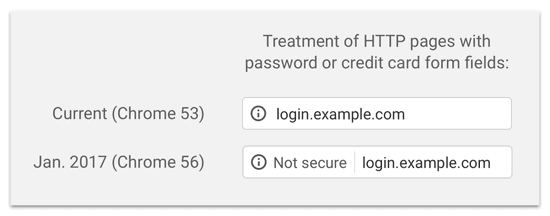
If so you might have missed a recent update where chrome browsers would start marking websites without an SSL certificate as not secure as of July 2018.
No idea what an SSL certificate is?
All good, I’m going to explain that:
An SSL certificate creates a secure connection from a web server to a browser. Essentially what this means is it makes it harder for hackers to see the details being shared, such as personal information when completing forms, login details, credit card information and so on.
This used to only be required for e-commerce sites but with online privacy being such a large issue now google is encouraging this to improve online security for all websites.
A site without an SSL has a domain that starts with just HTTP and will display the not secure warning. A domain with an SSL starts with https and will show the domain as secure.
Why Your Website Really Needs an SSL Certificate
You can leave your site as is if you like it will continue to work, but here are a few very strong reasons your website needs an SSL:
- Customer Trust – when site visitors see the not secure warning this could create a bad impression or make them hesitant to interact with your website.
- Search engine ranking – In an effort to make the internet safer, google rewards sites that have an SSL certificate, making them rank better than those without.
- Security – The purpose of an SSL is to secure information being sent across the site, protecting your personal details and providing protection from phishing attacks.
So there are some pretty strong incentives to make the switch!
How to add SSL to your site
1. Get yourself an SSL certificate
Most hosting companies will provide one for free as part of their hosting package so it’s worth getting in touch with them to find out. Otherwise, you can expect to spend anywhere between $50 – $250 / year (in the majority of cases). Price varies with certain inclusions/ad-ons that come with the certificate.
2. Install it on your website
After you have enabled the SSL for your domain, you then need to install it on your website. This can be done via a couple of methods;
a) via the use of a plugin that sets up redirects from HTTP to HTTPS. This is a quick and simple way to do it, however, you usually have to leave the plugin in place or it could create mixed content errors if you remove it afterward. Furthermore, having some redirects on your site is ok, but it can sometimes affect site performance and page rank.
b) A more permanent (and better solution) is to manually edit the WordPress files or do a fresh re-install of your site using the https protocol. You will most likely need the help of a developer to sort this out for you. If you would like our assistance please contact us.
Helpful Links
Here are some related articles you might find useful:
- Do SSL Certificates Affect Search Rankings? (A Data Driven Answer…)
Do you know that 68% of internet users believe that current laws for protecting their rights are not good enough? No wonder Google has taken a strict stance… - Is HTTPS Good for SEO
Does HTTPS impact SEO? Can it affect your rankings, traffic, and conversions? Click here to learn more about website security and its effects!
The post Website not secure? – Here’s how to fix it appeared first on Rivmedia Web Design.
]]>The post Do you have a mobile-friendly website? appeared first on Rivmedia Web Design.
]]>Mobile-friendly website:
How does yours measure up?
You may already be aware that your website should… no must be mobile-friendly these days.
Not only will Google penalise your site in their search results if it isn’t, but in the fast-paced, impatient society we live in, visitors to your site might punish you too.
When a website isn’t mobile responsive you’re forced to have to try and zoom in to be able to read small text, links are a pain to click on and sometimes content isn’t even viewable on the screen.
As a result, most users get frustrated, give up, and leave.
So not only are these websites losing customers but this can also affect what’s called “bounce rate.” Basically this is a percentage that is calculated based on how much time a visitor stays on your site. The longer they stay, the better the bounce rate which is another factor that contributes to how your website shows up in search engine results.
If people are abandoning your site quickly, google will see that as a sign that your website isn’t very useful and your rankings can drop even further.
The solution is straightforward; your website simply has to be mobile-friendly, or be prepared to suffer the consequences.
Some developers are able to convert a website to a mobile-friendly one, but often it’s just easier to start again and a fresh look never hurts anyway.
Yes, it does mean you have to spend more money, but what will it cost you if you don’t?
More Helpful Links
Here are some related articles you might find useful:
- Mobile-Friendly Test – This test will analyze a URL and report if the page has a mobile-friendly design.
- Google Webmaster Central Blog – Helping users find mobile-friendly pages
Need help ensuring you have a mobile-friendly website?
Rivmedia Web Design specialises in creating and maintaining high-quality, purpose-driven websites that convert visitors into customers. Get in touch with us today and let’s chat about how you can get the most out of your website.
The post Do you have a mobile-friendly website? appeared first on Rivmedia Web Design.
]]>The post New Website Now What? appeared first on Rivmedia Web Design.
]]>New website. Now what?
So you’ve got yourself a brand new website, or perhaps you’ve had one for a while now but not much is happening?
The Internet is one of the easiest methods of connecting with your target group of customers and is the method through which many of your potential and future customers will do their research on you. However, a website is not a magic wand that will instantly create business and sales. You have to work at it, build onto it, promote it, and work to increase its ranking in the Google search system.
Having a well-designed website (both in appearance and functionality) used to be enough on its own to get top ranking websites but over the years google algorithms have changed, become more sophisticated and a lot more demanding. So be prepared to be patient, especially if you have lots of competition as climbing up the google ranks can take time, from weeks to months, even longer depending on your niche.
Here are some steps to help you climb the google ladder:

1. Build Your SEO
SEO (Search Engine Optimisation) is the way in which online search engines such as Google decide what sites to show people when they search for something on the Internet. As your website is already complete I won’t discuss on-page SEO but there are things you can do to help improve your website’s online presence.
Backlinks – You must add relevant links back to your page throughout the web; these are called “backlinks.”
“www” stands for World Wide Web – Web being the operative word. No website was meant to be an island, but rather a part of a much larger interconnected “web” which is why google favours sites that advocate this. Plus, the number of backlinks your site has is an indication of its popularity and importance. Think about it, if another website links to you they obviously see your site as valuable and relevant, so google will recognise that also. Keep in mind, that backlinks need to be quality backlinks, that is, they are relevant and from reputable websites themselves. So don’t fall for shoddy backlink campaigns or link exchange scams! – Poor quality backlinks can actually do more harm than good, so be selective!
Where can you get backlinks from?
- Guest posts – A common method for getting backlinks is by writing guests posts on other reputable websites in your niche. This method has been quite abused of late but done correctly can give your site a boost, as well as make you an authority in your niche and hopefully get targeted referral traffic too. Here’s a fantastic article on writing guests posts to help guide you – The Definitive Guide to Guest Blogging by Brian Dean
- Directories – There are heaps that are available that have both free and paid options but these are to be used with caution; like backlinks from poorly ranked sites, directory listings can sometimes be harmful too so try to stick to those that are well known with good page ranks. You also need to check if these links from directories (and all websites) are actually counted too as some add what is called a no-follow link which means google doesn’t even count it as a backlink. If you can find locally based directories obviously that’s a big bonus too. You could also consider local business chambers, council business directories, and so on.
- Provide Testimonials – All businesses love displaying testimonials on their website and will often include a link to the provider’s website to prove that it is genuine, so take the time to write some. In doing so they will probably write a testimonial for you in return also which has extra valuable benefits in itself!
- Blog Reviews – Find quality blogs within your niche and contact them about what product or service you provide. Offer them a freebie product or service in exchange for a mention on their blog or better still, perhaps even writing a review about it. Don’t just straight out ask for a link though as that’s spammy and could violate Google’s Webmaster Guidelines.
- Google My Business Profile – You’ll need a Google My Business profile to set up your Google My Business business page (I will discuss further down) so it’s worth setting one up. Within the about section of your profile you can write about yourself and what you do… and guess what, include links to your website!
There are a lot more methods you can use to get backlinks but personally I find the above the quickest and simplest, so get on it!
2. Get your Social Media Sorted
Social media activity can be used as an indicator to search engines for a website’s credibility and popularity, as well as help determine which sites are relevant based on the given keyword search. That combined with the popularity of social media sites these days highlights the importance of having a social media presence. Which platforms (i.e. Facebook, Instagram, Pinterest, etc.) you use will depend on your business type, but Google My Business is one I would strongly recommend.

Google My Business may not be as popular as other social media platforms, however having a Google My Business page will help your google ranking and is a lot more important than most people realise. I have another article which discusses Google My Business and it’s importance here, but in the meantime here are some quick steps to get you started:
If you don’t have a physical location (i.e. you work from home or just operate online) you can still claim a page and simply select “I deliver goods and services to my customers at their location.” You will still need to fill in your address, but only your suburb will be displayed to the public. Do this as soon as you can as Google will actually send you a validation code via snail mail to verify your business and this can take a couple of weeks.
Click here to Claim Your Google My Business Business Page
3. Ask for Reviews
An online review is equally important as a personal recommendation these days and when people are looking for information about your business, finding reviews can not only be a great marketing tool but it can help boost your SEO as well. The more online content that is written about your business, the more relevant it will appear to search engines, so don’t be shy about asking for reviews!
4. Google Adwords
AdWords is the name of Google’s advertising platform. In general, most people will click on the organic results over paid results, and running an AdWords campaign won’t boost your online rankings.
However, if you have room in your budget, AdWords can be a helpful option to use, particularly in the early stages of your website’s launch. Firstly, it can help drive traffic to your site that you might not have had if your page isn’t ranking well yet. And second, it helps build your brand because even if someone doesn’t click on an Ad, they may see it and remember you next time they search for your particular product or service.
You can also completely control your budget with Adwords, by setting a limit to your daily spend and then adjusting as you go.
When Can You Begin to See Results?
Again, be patient. Climbing up the google ladder takes time. Follow the above steps, build your presence on social media and keep an eye on how people interact with your website, and make changes as necessary.
Good luck!
Helpful Links
Here are some related articles you might find useful:
- Backlinko – The Definitive Guide to Guest Blogging by Brian Dean
- Smart Passive Income – Your Website Is Up—Now What? 5 Things You Can Do To Market and Promote Your Website
- Search Engine Watch – 30 Free Ways To Market Your Small Business Site
- Forbes – 10 Proven Ways To Market Your Website
Still need help with your new website?
Rivmedia Web Design specialises in creating and maintaining high-quality, purpose-driven websites that convert visitors into customers. Get in touch with us today and let’s chat about how you can get the most out of your website.
The post New Website Now What? appeared first on Rivmedia Web Design.
]]>